

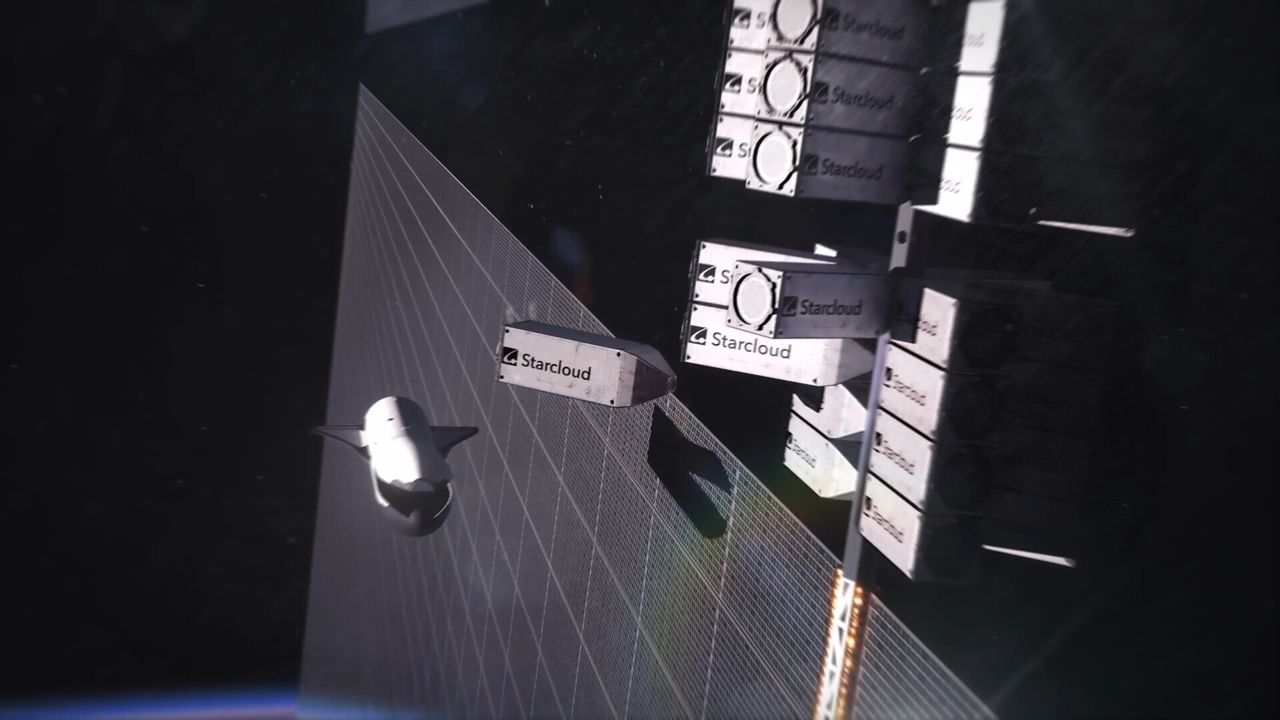
The prospect of deploying artificial intelligence infrastructure beyond Earth's atmosphere has long captivated futurists and engineers alike. With 2027 posited as a potential inflection point, the concept of data centers in orbit is transitioning from theoretical musings to a tangible, albeit highly complex, engineering challenge. This speculative deep dive explores the technical underpinnings, potential benefits, and formidable hurdles associated with establishing AI processing capabilities in the vacuum of space, fundamentally altering our approach to data computation and cosmic exploration.
Scientific Significance
As a Science Editor, I've analyzed the burgeoning discourse surrounding orbital data centers, recognizing their profound scientific and technological implications. The shift of high-performance computing, particularly for AI workloads, to space represents a paradigm shift in resource allocation and operational strategy. Our current terrestrial data centers face inherent limitations, including geographical latency, energy consumption, and vulnerability to natural disasters or geopolitical disruptions. Moving these critical assets off-world could mitigate many of these issues, offering unprecedented advantages for scientific research and commercial applications.
- Research Methodology & Data Accuracy: The foundational research for space-based data centers involves extensive modeling and simulation, focusing on microgravity effects, radiation hardening, thermal management in vacuum, and ultra-low latency communication protocols. Ensuring data integrity and computational accuracy in an environment rife with cosmic rays and solar flares necessitates advanced error correction codes and redundant systems, far exceeding typical terrestrial requirements.
- Future Implications: The implications for space exploration are particularly compelling. On-orbit AI could process vast datasets from telescopes and planetary probes with minimal latency, accelerating discovery and enabling more autonomous missions. For Earth-bound applications, it could provide a global, resilient computing backbone, especially for edge computing scenarios where proximity to the data source is paramount.
- Academic Consensus & Emerging Field: While still an emerging field, there is a growing academic consensus on the theoretical feasibility, with significant research efforts underway in areas like advanced propulsion for deployment, satellite constellation management, and novel cooling technologies. The interdisciplinary nature of this endeavor, spanning aerospace engineering, computer science, and astrophysics, underscores its complexity and potential for groundbreaking innovation.
Core Functionality & Architecture
The architecture of a space-based data center would diverge significantly from its terrestrial counterparts, driven by the unique environmental constraints of orbit. At its core, such a facility would comprise modular computing units, robust power generation systems, advanced thermal management, and sophisticated communication arrays.
- Power Generation: Solar arrays would serve as the primary power source, requiring substantial surface area and efficient energy storage systems, likely advanced battery technologies or regenerative fuel cells, to sustain operations during orbital night.
- Thermal Management: The vacuum of space presents both a challenge and an opportunity for cooling. While convection is absent, radiative cooling becomes highly efficient. Systems would likely employ large radiator panels, potentially augmented by phase-change materials or advanced fluid loops, to dissipate the immense heat generated by high-density AI processors.
- Communication Infrastructure: High-bandwidth, low-latency optical communication links would be essential for transmitting data to and from Earth. This would involve a network of ground stations and potentially inter-satellite laser links to form a robust orbital mesh network, minimizing signal propagation delays.
- Modular Design: A modular approach would facilitate deployment, maintenance, and scalability. Individual computing modules, potentially specialized for different AI workloads (e.g., neural network training, inference), could be launched separately and assembled in orbit, allowing for incremental expansion and component replacement.
- Autonomous Operations: Given the prohibitive cost and complexity of human intervention, these data centers would require highly autonomous operational protocols, including self-diagnosis, self-repair capabilities, and AI-driven resource management to optimize power, cooling, and computational load.
Performance & Security Considerations
Operating data centers in space introduces a unique set of performance and security challenges that necessitate innovative solutions.
- Efficiency: Maximizing computational efficiency per watt is paramount due to launch mass constraints and power generation limitations. This drives the adoption of highly optimized, low-power AI accelerators and efficient data compression algorithms. The absence of atmospheric drag at higher orbits could also contribute to long-term orbital stability, reducing fuel consumption for station-keeping.
- Battery Life & Power Management: The reliance on solar power mandates sophisticated energy storage and power management systems. The "battery life" of the orbital data center would be dictated by the longevity and degradation rates of its energy storage components, requiring robust charge-discharge cycles and intelligent load balancing to ensure continuous operation.
- Encryption & Data Integrity: Data transmitted between Earth and orbit, and within the orbital network, would require state-of-the-art encryption protocols to protect against eavesdropping and cyber threats. Furthermore, the space environment's radiation can induce bit flips, necessitating advanced error detection and correction mechanisms at every layer of the data stack to maintain data integrity.
- Authentication & Access Control: Establishing secure authentication mechanisms for accessing and managing orbital data center resources is critical. This would likely involve multi-factor authentication, hardware security modules (HSMs), and potentially quantum-resistant cryptographic methods to safeguard against unauthorized access in such a high-value, remote asset.
| Metric/Feature (Key) | Value/Description (Value) |
|---|---|
| Primary Power Source | Solar Arrays with Advanced Energy Storage (e.g., Li-ion, Solid-State Batteries, Regenerative Fuel Cells) |
| Cooling Mechanism | Passive Radiative Cooling, Advanced Fluid Loops, Phase-Change Materials |
| Communication Protocol | High-Bandwidth Optical (Laser) Links, Ka-band RF for Redundancy |
| Data Latency (Earth-Orbit) | Millisecond to Sub-second (depending on orbit and ground station network) |
| Radiation Shielding | Multi-layered Composite Materials, Active Magnetic Shielding (speculative) |
| Computational Architecture | Modular, Distributed AI Accelerators (e.g., specialized ASICs, FPGAs) |
| Operational Autonomy | High (AI-driven self-diagnosis, self-repair, resource management) |
| Security Posture | Quantum-Resistant Encryption, Hardware Security Modules, Multi-Factor Authentication |
Expert Verdict
The vision of AI data centers orbiting Earth by 2027, while ambitious, is a testament to humanity's relentless pursuit of technological frontiers. The technical hurdles—from radiation hardening and thermal management to ultra-secure, low-latency communication—are immense, yet the potential rewards in terms of scientific discovery, global connectivity, and computational resilience are equally profound. As a Science Editor, I view this endeavor not merely as an engineering challenge but as a strategic imperative for the future of AI and space exploration. The successful deployment of such infrastructure would not only unlock new computational paradigms but also fundamentally reshape our understanding of what is possible beyond the confines of our planet. The journey to orbital AI is fraught with complexity, but the destination promises an unprecedented leap forward for technology and science alike, perhaps even influencing future deep space missions or the establishment of lunar bases. Unlocking Tomorrow: The Future of Technology Unveiled will undoubtedly be shaped by these extraterrestrial advancements.