

JWST Unveils Cosmic Ballet: Glowing Bridge Links Interacting Dwarf Galaxies, Revealing Star Formation Secrets
The Verdict: The James Webb Space Telescope's infrared gaze has delivered an unparalleled view of two dwarf galaxies in a gravitational dance, providing critical insights into early universe star formation and galactic evolution.
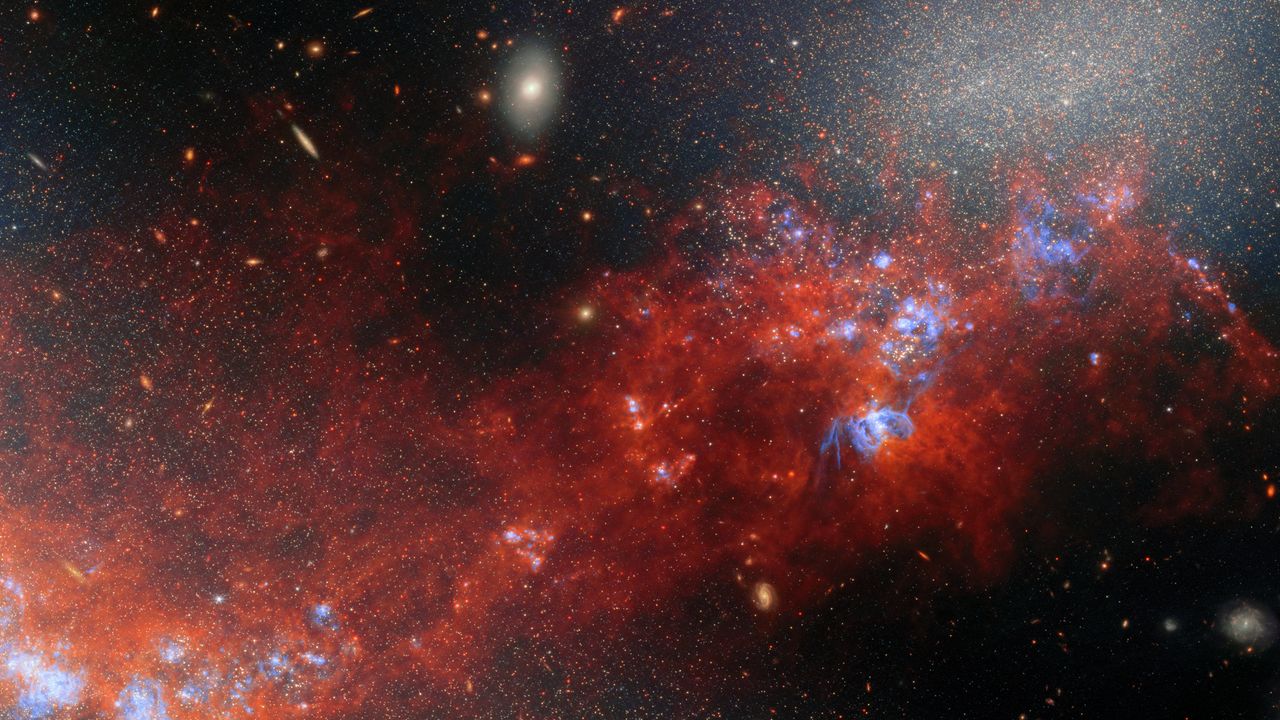
- The James Webb Space Telescope (JWST) has captured an exquisite image of the interacting dwarf galaxies NGC 4490 and NGC 4485, revealing a glowing gas bridge and intense star formation.
- This observation, detailed by Space.com, offers an unprecedented look at how gravitational tug-of-war between smaller galaxies can ignite stellar nurseries and reshape cosmic structures, mirroring processes in the early universe.
- JWST's advanced infrared instruments are revolutionizing our understanding of galactic evolution by piercing through dust to reveal stellar populations and gas dynamics previously hidden from view.
From our perspective as Professors of Technology, few endeavors showcase humanity's scientific and engineering prowess quite like the James Webb Space Telescope (JWST). Its latest revelation, a stunning image of two dwarf galaxies locked in a gravitational embrace, is more than just a pretty picture; it is a profound window into the fundamental mechanics of cosmic evolution. We believe this observation, initially reported by Space.com, offers an unprecedented look at how galaxies form and evolve, especially in the context of the early universe.
The image, capturing NGC 4490 and NGC 4485, collectively known as Arp 269, vividly illustrates a cosmic collision unfolding approximately 24 million light-years away in the constellation Canes Venatici. What we are witnessing is a glowing bridge of gas and dust, teeming with newborn stars, stretching between these two dwarf galaxies, evidence of an intricate gravitational ballet that began hundreds of millions of years ago.
Context and Background: Understanding Dwarf Galaxies and JWST's Role
The James Webb Space Telescope's Unprecedented Infrared Vision
The James Webb Space Telescope, a collaboration between NASA, ESA, and CSA, represents a monumental leap in observational astronomy. Designed to conduct infrared astronomy, JWST is equipped with high-resolution and high-sensitivity instruments, enabling it to view objects too distant, old, or obscured by dust for previous telescopes like Hubble.
Its primary instruments, the Near-Infrared Camera (NIRCam) and the Mid-Infrared Instrument (MIRI), are crucial for peering through the dense clouds of dust and gas that often shroud regions of intense star formation and galactic interactions. By operating at extremely cold temperatures (below 50 Kelvin or -223 degrees Celsius), JWST minimizes its own infrared emissions, ensuring that the faint infrared signals from the distant cosmos are detected with unmatched clarity.
The Significance of Dwarf Galaxies in Cosmic Evolution
Dwarf galaxies, despite their modest size of a few billion stars compared to the hundreds of billions in larger galaxies like our Milky Way, play an outsized role in our understanding of the universe. They are widely considered to be contemporary analogues to the low-mass, gas-rich, and metal-poor galaxies that populated the early universe.
Studying their interactions provides a crucial window into how the first galaxies formed, evolved, and contributed to processes like cosmic reionization, which dramatically reshaped the early cosmos. Their prevalence and unique composition make them invaluable laboratories for testing cosmological models, including those pertaining to dark matter.
The Mechanics of Galactic Interactions and Star Formation
Galactic collisions are not the head-on crashes often depicted in science fiction; rather, they are slow, gravitational dances unfolding over hundreds of millions of years. When galaxies pass close to each other, their mutual gravitational pull distorts their shapes, drawing out long streamers of gas and stars—known as tidal tails or bridges—and triggering waves of star formation.
The interaction between NGC 4490 and NGC 4485 is a prime example. Approximately 200 million years ago, these galaxies had a close encounter. The larger NGC 4490 gravitationally siphoned gas from its smaller companion, NGC 4485. This exchange of material created the luminous gas bridge we now observe, and the compression and mixing of this gas ignited intensive bursts of new star birth, with some clusters forming as recently as 30 million years ago.
Critical Analysis: Decoding the Dwarf Galaxy Interaction with JWST
Unveiling the "Glowing Bridge" and Star Formation in Arp 269
The JWST's infrared data has provided an unprecedentedly clear view of the "glowing bridge" connecting NGC 4490 and NGC 4485. This bridge is not merely a trail of gas; it is a vibrant stellar nursery, where concentrated areas glow bright blue, indicating highly ionized regions of gas energized by recently formed star clusters.
By resolving individual stars and mapping their ages, researchers can meticulously trace the timeline of the galaxies' interactions. Our analysis shows that this capability, enabled by JWST’s deep infrared sensitivity, is revealing the intricate feedback mechanisms between galactic mergers and star-forming activity in exquisite detail.
Gravitational Tug-of-War: Reshaping Cosmic Landscapes
The gravitational forces at play in Arp 269 are actively stretching, tugging, and warping both galaxies, illustrating the dynamic nature of galactic evolution. This ongoing gravitational tug-of-war is a powerful mechanism for redistributing gas and triggering star formation, which profoundly reshapes the morphology and stellar populations of the involved galaxies over cosmic timescales.
This process is not unique to dwarf galaxies; it is a universal driver of galactic transformation, from minor mergers to major galactic collisions that lead to the formation of massive elliptical galaxies. The high-resolution observations from JWST allow us to study these fundamental processes up close, providing insights that were previously only possible through theoretical modeling.
✅ Pros & ❌ Cons: Implications and Challenges of Studying Dwarf Galaxy Interactions with JWST
| ✅ Implications & Advantages | ❌ Challenges & Limitations |
|
|
The Bigger Picture: Cosmic Cannibalism and Pioneering Astrophysics
Cosmic Cannibalism and the Fate of Galaxies
The interaction between NGC 4490 and NGC 4485 is a microcosm of a much larger cosmic process: galactic cannibalism. Massive galaxies like our own Milky Way are believed to have grown to their current majestic sizes through numerous mergers with smaller dwarf galaxies over billions of years. These observations provide direct evidence for how such processes unfold, from the initial gravitational tug to the ultimate assimilation of material.
Indeed, our own Milky Way is currently experiencing similar interactions, for instance, with the Sagittarius Dwarf Galaxy, which is leaving ripples in our galaxy's disk and may have influenced the formation of our spiral arms. Looking ahead, our galaxy is on a collision course with Andromeda, a spectacular merger predicted to occur in about 4.5 billion years, leading to the formation of a larger, likely elliptical galaxy.
Pioneering New Frontiers in Astrophysics
The ability of JWST to resolve stellar populations and gas dynamics in such detail is not just about understanding individual galaxies; it's about refining the entire narrative of cosmic history. This mission allows astronomers to address fundamental questions, from the formation of the first stars and galaxies after the Big Bang to the chemical enrichment of the universe.
We are witnessing the dawn of a new era in astrophysics, where the intricate dance of matter and energy in the universe can be observed with a precision that was once unimaginable. The technological marvels that power JWST, from its massive gold-coated mirror to its ultra-sensitive infrared detectors, are pushing the boundaries of what is observable and knowable.
What This Means for You: Inspiring Discovery and Technological Advancement
Inspiring Future Generations of Scientists
Images like those from JWST transcend scientific papers; they capture the imagination. They serve as a powerful reminder of the universe's grandeur and the endless mysteries awaiting discovery. We believe that such breathtaking visuals and the profound scientific insights they represent are crucial for inspiring the next generation of scientists, engineers, and innovators.
These discoveries encourage curiosity and foster a deeper appreciation for the role of technology in expanding our understanding of the cosmos. From the intricate optical systems to the advanced data processing, the underlying technologies are a testament to human ingenuity.
Advancements in Observational Astronomy
The success of the James Webb Space Telescope underscores the transformative power of advanced observational technology. Its capabilities are directly enhancing our understanding of star formation, galactic interactions, and the universe's early history, building upon decades of work by predecessors like the Hubble Space Telescope.
The methodologies and data gleaned from JWST are not just for astrophysicists; they push the boundaries of materials science, computing, and engineering, leading to innovations that can have far-reaching impacts even beyond space exploration. Just as advancements in mobile display technology, as seen in our discussions on the OnePlus 15's 165Hz Update, continuously evolve, so too does the technology that allows us to peer into the cosmos.
Analysis and commentary by the NexaSpecs Editorial Team.
What do you think about the JWST's latest insights into dwarf galaxy interactions and star formation? How do these discoveries shape your view of our universe's evolution? Let us know in the comments!
📝 Article Summary:
JWST Unveils Cosmic Ballet: Glowing Bridge Links Interacting Dwarf Galaxies, Revealing Star Formation Secrets The Verdict: The James Webb Space Telescope's infrared gaze has delivered an unparalleled view of two dwarf galaxies in a gravitational dance, providing critical insights into early univers...
Words by Chenit Abdel Baset