

The annual NeurIPS conference consistently serves as a crucible for artificial intelligence innovation, and this year, NVIDIA has once again seized the spotlight. We've witnessed a consistent push from the silicon giant towards democratizing AI, a narrative that their latest announcements at NeurIPS aim to reinforce. This isn't just about faster chips; it's about shaping the very foundation upon which future AI applications will be built, both in the digital and physical realms.
- NVIDIA is significantly expanding its open AI model, dataset, and tool offerings, notably with Alpamayo-R1 for autonomous driving and new additions to the Nemotron family for digital AI.
- The introduction of Alpamayo-R1 marks a pivotal step in physical AI, integrating sophisticated chain-of-thought reasoning for autonomous vehicles to navigate complex scenarios more like humans.
- NVIDIA's commitment to open source is further validated by its high ranking in the Artificial Analysis Openness Index for the Nemotron family, though the long-term implications of this 'openness' warrant scrutiny.
- New Nemotron tools and datasets, including MultiTalker Parakeet and NeMo Gym, aim to bolster speech AI, content safety, and reinforcement learning environments for LLMs.
Understanding NVIDIA's Open AI Strategy at NeurIPS
From our perspective, NVIDIA's presence at NeurIPS this year is a calculated maneuver to solidify its position not merely as a hardware provider, but as a foundational pillar for AI development across all sectors. The company's ongoing commitment to open-source technologies forms the bedrock of their strategy, aiming to equip researchers and developers worldwide with cutting-edge tools. We believe this approach fosters adoption and entrenches their ecosystem deeper into the global AI research community.
NVIDIA's Deepening Commitment to Open Source AI
The sheer breadth of NVIDIA's new offerings — spanning open AI models, diverse datasets, and versatile tools — underscores a strategic pivot. They are not merely contributing; they are attempting to define the very landscape of open AI. This dedication is not lost on independent evaluators; the Nemotron family, a cornerstone of NVIDIA's frontier AI development, has been recognized by the Artificial Analysis Openness Index as one of the most transparent and permissibly licensed open technologies in the ecosystem. Such endorsements, while positive, also prompt us to question the true definition of 'open' in an increasingly proprietary AI world.
NeurIPS: A Prime Platform for AI Innovation
NeurIPS, as one of the world’s foremost AI conferences, provides an unparalleled stage for these unveilings. NVIDIA's researchers are presenting over 70 papers, talks, and workshops, covering everything from advanced AI reasoning to medical research and autonomous vehicle development. This heavy academic engagement showcases a dual strategy: advancing fundamental research while simultaneously pushing their commercial solutions into the hands of the next generation of innovators. As we've discussed previously in our analysis of NVIDIA's Strategic Vision: Catalyzing the Future of AI with Graduate Research Fellowships, investing in the academic pipeline is crucial for long-term influence.
In-Depth Look: Alpamayo-R1 and Nemotron Models
Our critical analysis of NVIDIA's latest open AI initiatives reveals a calculated expansion into both the theoretical and practical applications of artificial intelligence. The new models, particularly Alpamayo-R1, represent significant strides in physical AI, while the Nemotron additions bolster the company's already formidable presence in the digital AI sphere.
NVIDIA DRIVE Alpamayo-R1: Revolutionizing Autonomous Driving
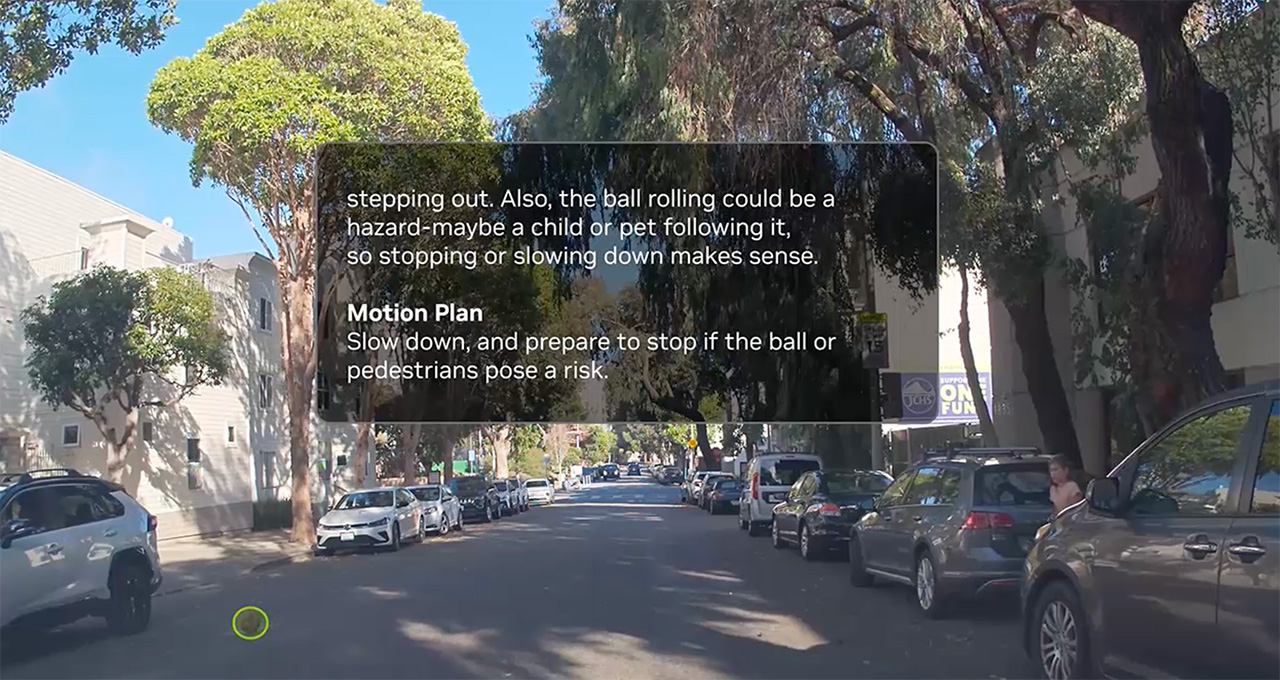
The star of the physical AI show is undoubtedly NVIDIA DRIVE Alpamayo-R1 (AR1). Heralded as the world’s first industry-scale open reasoning Vision Language Action (VLA) model for autonomous driving research, AR1 is designed to tackle the complex, nuanced situations that have historically plagued self-driving systems. We believe this model’s integration of chain-of-thought AI reasoning with path planning is a genuine breakthrough. Previous models often faltered in ambiguous scenarios—think bustling pedestrian intersections or unexpected lane closures. AR1, by contrast, aims to imbue autonomous vehicles with a more human-like 'common sense' for navigation.
This reasoning capability allows AR1 to break down a scenario, weigh various trajectories, and select the optimal route based on contextual data. For instance, an AV powered by AR1 in a dense urban environment could process real-time path data, incorporate reasoning traces (explanations for its actions), and then dynamically adjust its trajectory to avoid a bike lane or anticipate jaywalkers. Built on NVIDIA Cosmos Reason, AR1's open foundation offers researchers unprecedented flexibility to customize the model for non-commercial benchmarking and experimental AV applications. The observed significant improvement in reasoning capabilities post-reinforcement learning training further highlights its potential. AR1 is now readily available on GitHub and Hugging Face, with a subset of its training data accessible via NVIDIA Physical AI Open Datasets, complemented by the AlpaSim framework for evaluation.
The Cosmos Ecosystem and Physical AI
Beyond Alpamayo-R1, the broader NVIDIA Cosmos ecosystem continues to evolve, offering a comprehensive suite for physical AI developers. The newly released Cosmos Cookbook provides step-by-step recipes and workflows for using and post-training Cosmos-based models, covering everything from data curation to synthetic data generation and model evaluation. This move is crucial for accelerating development in areas requiring realistic simulations and robust robotic policies. We see virtually limitless possibilities for Cosmos-based applications, evident in examples such as:
- LidarGen: The first world model capable of generating lidar data for AV simulation. This synthetic data generation capability is a critical enabler for training robust autonomous systems without the prohibitive costs of real-world data collection.
- Omniverse NuRec Fixer: A model leveraging NVIDIA Cosmos Predict to rectify artifacts in neurally reconstructed data, enhancing the fidelity of AV and robotics simulations.
- Cosmos Policy: A framework designed to transform large, pretrained video models into reliable robot policies, dictating precise robot behavior.
- ProtoMotions3: An open-source, GPU-accelerated framework for training physically simulated digital humans and humanoid robots within realistic scenes generated by Cosmos world foundation models (WFMs).
The ability to train policy models in NVIDIA Isaac Lab and Isaac Sim, with generated data then feeding into NVIDIA GR00T N models for robotics, demonstrates a tightly integrated, end-to-end development pipeline. This holistic approach is why we've observed numerous ecosystem partners, including Voxel51, 1X, Figure AI, and researchers at ETH Zurich, actively developing their latest physical AI technologies with Cosmos WFMs.
Nemotron and Digital AI Advancements
On the digital AI front, NVIDIA is bolstering its Nemotron family with several critical additions for developers. These advancements primarily focus on multi-speaker speech AI, AI safety, and the generation of high-quality synthetic datasets.
- MultiTalker Parakeet: An automatic speech recognition model tailored for streaming audio, designed to accurately transcribe conversations with multiple, even overlapping, speakers.
- Sortformer: A state-of-the-art model for real-time speaker diarization, efficiently distinguishing individual speakers within an audio stream.
- Nemotron Content Safety Reasoning: A reasoning-based AI safety model that dynamically enforces custom policies across various domains, addressing a growing concern in AI deployment.
- Nemotron Content Safety Audio Dataset: A synthetic dataset crucial for training models to detect unsafe audio content, enabling robust guardrails across text and audio modalities.
- NeMo Gym: An open-source library simplifying and accelerating the development of reinforcement learning environments for Large Language Model (LLM) training, including environments for Reinforcement Learning from Verifiable Reward (RLVR).
- NeMo Data Designer Library: Now open-sourced under Apache 2.0, this comprehensive toolkit facilitates the generation, validation, and refinement of high-quality synthetic datasets for generative AI development, enabling domain-specific model customization and evaluation.
The collaboration with ecosystem partners like CrowdStrike, Palantir, and ServiceNow, who are utilizing NVIDIA Nemotron and NeMo tools, underscores the practical impact of these digital AI enhancements. These tools are pivotal for building secure, specialized agentic AI, which aligns with the industry's broader push towards more capable and responsible AI systems. This ongoing development of the Nemotron family is a testament to NVIDIA's dedication to what we have previously identified as frontier AI development and the revolutionizing power of models like Blackwell NVL72.
What This Means for You
For researchers and developers, NVIDIA's expanded open AI initiatives represent a significant boon. The availability of advanced models like Alpamayo-R1, coupled with robust development frameworks such as the Cosmos Cookbook and NeMo Gym, provides powerful tools for accelerating innovation in both physical and digital AI. This push could democratize access to sophisticated AI capabilities, lowering the barrier to entry for smaller teams and independent researchers. However, we must also consider the strategic implications of a single company exerting such influence over what it defines as 'open' source.
While the open nature of these models allows for customization and benchmarking, the underlying hardware dependency on NVIDIA's powerful GPUs remains a critical factor. This creates a fascinating tension: fostering an open software ecosystem while maintaining a strong grip on the essential compute infrastructure. For industries like autonomous vehicles, the promise of more intelligent and safer systems through models like Alpamayo-R1 is immense, potentially paving the way for wider adoption of Level 4 autonomy. In digital AI, the enhancements to speech recognition and AI safety tools are vital for building more robust and ethically sound AI applications, particularly as large language models become increasingly pervasive.
Pros & Cons of NVIDIA's Open AI Strategy
| Pros | Cons |
|---|---|
| Accelerated Innovation: Open models and tools foster rapid development and experimentation across the AI community. | Hardware Lock-in: While software is open, optimal performance often necessitates NVIDIA's proprietary GPU hardware. |
| Enhanced Accessibility: Researchers and developers gain access to cutting-edge models and datasets, reducing resource barriers. | Defining 'Openness': NVIDIA's definition of open source, though recognized, still places them at the center of the ecosystem, potentially limiting true decentralization. |
| Improved AI Safety & Ethics: Dedicated models and datasets for content safety help build more responsible AI systems. | Dominance Concerns: NVIDIA's increasing influence could lead to a less diverse and competitive AI landscape in the long run. |
| Advanced Autonomous Capabilities: Models like Alpamayo-R1 promise more intelligent and safer autonomous driving systems through reasoning. | Complexity and Specialization: The sheer volume and specialization of tools might overwhelm some developers, requiring significant learning curves. |
| Ecosystem Integration: Tightly integrated tools (Cosmos, NeMo, Isaac Sim) streamline development from simulation to deployment. | Commercial vs. Research Focus: The 'non-commercial use' clause for some models limits direct commercial application without further licensing. |
NVIDIA's strategic push towards open AI, exemplified by Alpamayo-R1 and the expanded Nemotron family, is a powerful indicator of the industry's direction. It's a future where AI capabilities are increasingly accessible, yet simultaneously, the infrastructure underpinning them remains critically centralized. What are your thoughts on NVIDIA's 'open' strategy and its potential impact on the future of AI development? Let us know in the comments below!
Frequently Asked Questions
Analysis and commentary by the NexaSpecs Editorial Team.
Interested in NVIDIA Alpamayo-R1, NVIDIA Nemotron?
Check Price on Amazon →NexaSpecs is an Amazon Associate and earns from qualifying purchases.
📝 Article Summary:
NVIDIA is significantly expanding its open AI ecosystem at NeurIPS, unveiling Alpamayo-R1 for autonomous driving and enhancing the Nemotron family for digital AI. We critically analyze NVIDIA's commitment to open-source models and their implications for the future of AI development, highlighting both potential benefits and strategic concerns.
Keywords:
Words by Chenit Abdel Baset