

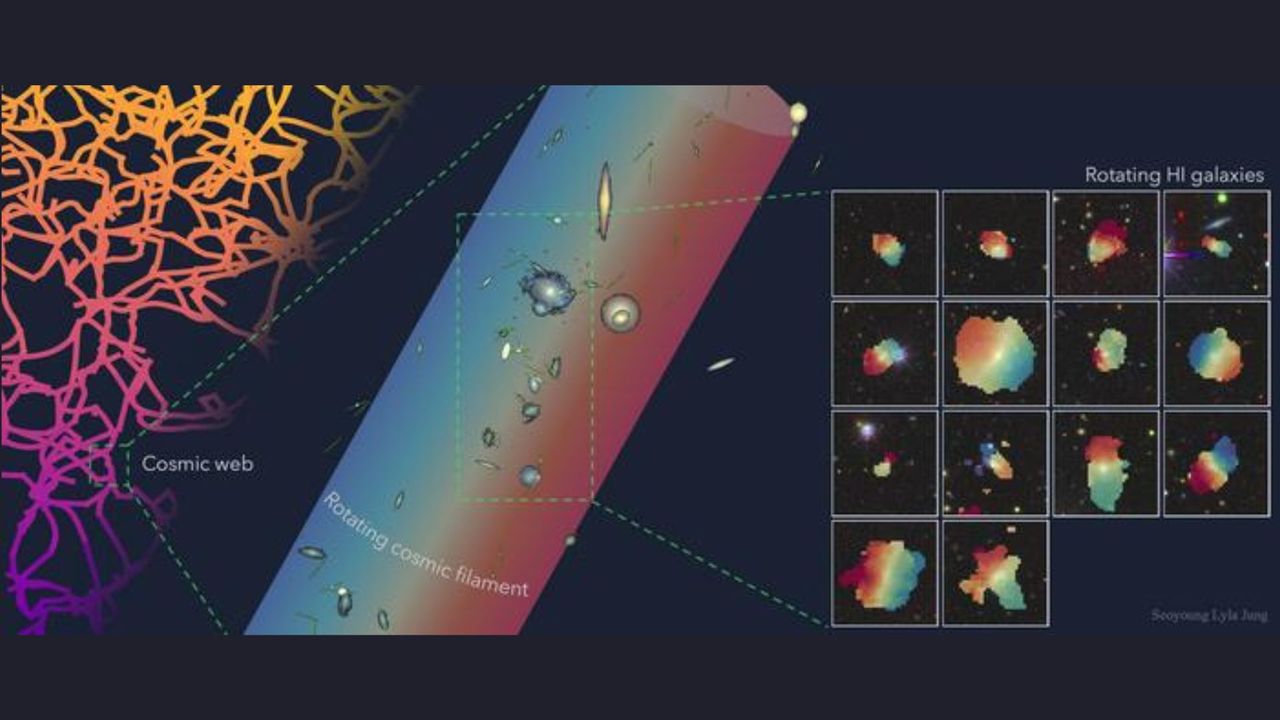
Cosmic Choreography: The Spinning Thread Reshaping Our View of Galactic Evolution
The Verdict: The groundbreaking discovery of a colossal, spinning cosmic filament, a staggering 50 million light-years long, fundamentally challenges our understanding of how galaxies acquire their spin and evolve within the universe's grand design.
- Scientists have identified one of the universe's largest spinning structures: a 50-million-light-year-long cosmic filament located 140 million light-years away, with galaxies rotating in sync with its bulk motion.
- This discovery, largely facilitated by the MeerKAT radio telescope, provides unprecedented insights into the transfer of angular momentum from large-scale cosmic structures to individual galaxies.
- The phenomenon challenges existing cosmological models by suggesting that the cosmic environment exerts a far more profound and prolonged influence on galaxy spin and evolution than previously theorized.
From our perch on Earth, the universe often appears as a mix of isolated galaxies, each spinning in its own celestial dance. Yet, the cosmos is far more interconnected and dynamically complex than a casual glance might suggest. We've long understood that galaxies are not randomly scattered, but rather organized into a vast, intricate network known as the cosmic web. This monumental scaffolding, composed primarily of dark matter and laced with ordinary matter, dictates the large-scale structure of the universe, with galaxies clustering at nodes and along filamentary bridges.
Recently, a team of international scientists, drawing on initial data reported by Space.com, unveiled a discovery that has sent ripples through the astrophysical community: one of the universe's largest spinning structures, a cosmic thread stretching an astounding 50 million light-years. This colossal filament isn't merely a static highway for matter; it's a dynamic, rotating entity, with the galaxies embedded within it exhibiting a synchronized spin. This finding potentially transforms what we think about how the cosmic environment influences galaxies as they form and evolve.
The Discovery of the Rotating Cosmic Filament
The cosmic web, a theoretical construct for decades, describes the universe as a vast network of voids, sheets, and filaments. These filaments are like super-highways of gas and dark matter, channeling material into denser regions where galaxies and galaxy clusters reside. While previous research, including studies from 2022, had suggested that these cosmic filaments themselves might rotate, this new observation goes a significant step further.
What makes this particular discovery so exceptional is the revelation that galaxies within the filament are not just moving along its length, but are actively rotating in alignment with the filament's overall spin. Imagine, as co-lead author Dr. Lyla Jung of the University of Oxford vividly describes, a "teacups ride at a theme park." Each galaxy is a spinning teacup, but the entire platform—the cosmic filament—is rotating as well. This dual motion provides an unprecedented glimpse into the intricate mechanics of cosmic angular momentum transfer.
MeerKAT's Role in Unveiling Cosmic Spin
The detection of this monumental spinning structure, located some 140 million light-years away, was a testament to the power of modern astronomical instrumentation. The international team primarily utilized the MeerKAT radio telescope in South Africa. This array, comprising 64 interlinked dishes, is incredibly sensitive to the faint radio signals emitted by neutral hydrogen gas.
By mapping the motion of this hydrogen gas within the filament and its constituent galaxies, researchers could precisely measure their rotational dynamics. Complementary optical data from the Dark Energy Spectroscopic Instrument (DESI) at Kitt Peak National Observatory and the Sloan Digital Sky Survey (SDSS) further refined these observations, offering a comprehensive view of this cosmic ballet. This multi-observatory approach, as Professor of Astrophysics Matt Jarvis noted, is critical for gaining deeper insights into structure formation.
The Mechanics of Cosmic Rotation
The filament itself is truly enormous, housing approximately 300 galaxies within its 50-million-light-year span. More strikingly, at its core lies a "razor-thin" string of 14 galaxies, precisely aligned over 5.5 million light-years and just 117,000 light-years wide. A statistically significant number of these 14 galaxies were found to be rotating in the same direction as the larger filament, moving at an inferred velocity of about 110 kilometers per second.
This synchronized motion is a powerful indicator of a direct interaction between the large-scale cosmic structure and the individual galaxies it contains. We believe that atomic hydrogen gas, being easily disturbed by motion, acts as a superb tracer of how gas is funneled through these filaments into galaxies. This flow of gas also carries angular momentum, directly influencing the morphology, spin, and star formation processes within these young, hydrogen-rich galaxies.
Implications for Galactic Evolution and Dark Matter
The discovery of this spinning cosmic filament presents a compelling challenge to some prevailing cosmological models. For decades, theories of galaxy formation have grappled with the origin of galactic angular momentum. The standard model suggests that galaxies acquire their spin from gravitational tidal torques exerted by neighboring structures in the early universe. However, the observed synchronized rotation within such a colossal structure implies a more profound and sustained influence from the cosmic web than previously considered.
Our analysis shows that this filament acts as a "fossil record of cosmic flows," helping us to piece together how galaxies acquire their spin and grow over cosmic timescales. It suggests that the environment within these large-scale structures plays a direct and long-lasting role in shaping the rotational properties of galaxies, influencing their evolution in ways that traditional models may not fully account for. This could lead to significant refinements in our simulations of structure formation. We previously discussed the complexities of cosmic expansion and conflicting measurements in Unraveling the Hubble Tension: Cosmic Expansion, Conflicting Measurements, and the Quest for New Physics, and this discovery adds another layer to our understanding of the universe's dynamic processes.
Rethinking Angular Momentum on Cosmic Scales
The coherent spin observed in this filament provides strong evidence for the Tidal Torque Theory, which posits that gravitational asymmetries in the early universe imparted angular momentum to the forming cosmic web filaments, setting them into rotation. This mechanism then appears to transfer that momentum down to the individual galaxies within these filaments. The fact that the filament is considered "dynamically cold" and rich in hydrogen gas suggests it is a relatively young, undisturbed structure, making it an ideal laboratory for studying these initial stages of galaxy acquisition of spin.
Understanding this transfer of angular momentum is crucial for fully comprehending galaxy morphology and star formation rates. As hydrogen gas, the raw material for stars, flows into these galaxies along the spinning filament, its motion is directly influenced by the filament's rotation. This provides a direct link between the largest structures in the universe and the birth and evolution of stars within galaxies, a cosmic choreography on an unimaginable scale. Much like how the JWST Unveils Cosmic Ballet: Glowing Bridge Links Interacting Dwarf Galaxies, Revealing Star Formation Secrets, these observations highlight the intricate and interconnected nature of cosmic phenomena.
The Cosmic Web's Dynamic Influence
Another profound implication relates to dark matter. Cosmic filaments are predominantly composed of this mysterious, invisible substance, which provides the gravitational scaffolding for the entire cosmic web. The fact that baryonic (ordinary) matter, including the galaxies, follows the distribution and motion of the dark matter in these filaments underscores dark matter’s fundamental role in structure formation.
This discovery provides new avenues for studying the distribution and behavior of dark matter on vast scales. If the rotation of these filaments is driven by the gravitational dynamics of their dark matter component, then observing the spin of galaxies within them can offer indirect insights into the properties and distribution of dark matter itself. From our perspective, this is a significant step towards unmasking one of the universe's most elusive components.
Critical Analysis
✅ Pros & ❌ Cons
| ✅ Pros | ❌ Cons |
|
|
The Bigger Picture
The universe, at its grandest scales, is a blend of gravitational interactions and matter flows. The cosmic web is the conductor, guiding the evolution of everything we see. This discovery of a rotating filament, with galaxies dancing to its tune, paints an even more dynamic and interconnected picture of our cosmos. It underscores the profound realization that the environment in which a galaxy resides—even one spanning tens of millions of light-years—can fundamentally shape its destiny.
We are constantly refining our understanding of the universe, moving from static models to increasingly dynamic and complex ones. From the humble beginnings of the Big Bang, through epochs of dark matter collapse and the formation of the first stars, to the emergence of vast galaxy clusters, each new discovery adds another brushstroke to this magnificent cosmic portrait. This spinning filament is a vibrant new detail, reminding us of the hidden mechanics at play.
What This Means for You
While the study of cosmic filaments and galactic evolution might seem distant from our everyday lives, its implications are profoundly human. Understanding how galaxies form and evolve, and how they acquire their fundamental properties like spin, helps us contextualize our own existence. It allows us to trace the lineage of our own Milky Way galaxy back through cosmic time, understanding the forces that shaped it and, by extension, our solar system.
This research also highlights the relentless pursuit of knowledge by scientists, pushing the boundaries of technology with instruments like the MeerKAT telescope. It's a testament to human ingenuity and curiosity, reminding us that even in the vast emptiness of space, there are profound secrets waiting to be uncovered, secrets that continuously reshape our perception of reality and our place within it.
Analysis and commentary by the NexaSpecs Editorial Team.
What are your thoughts on this incredible cosmic discovery and its impact on our understanding of galactic evolution? Let us know in the comments below!
📝 Article Summary:
Cosmic Choreography: The Spinning Thread Reshaping Our View of Galactic Evolution The Verdict: The groundbreaking discovery of a colossal, spinning cosmic filament, a staggering 50 million light-years long, fundamentally challenges our understanding of how galaxies acquire their spin and evolve wit...
Words by Chenit Abdel Baset