

A groundbreaking study utilizing data from NASA’s Chandra X-ray Observatory challenges the prevailing astronomical consensus regarding the ubiquitous presence of supermassive black holes (SMBHs) in galactic centers. The research indicates that a significant majority of smaller galaxies may not host these colossal gravitational entities, a finding that redefines our understanding of galactic evolution and SMBH formation.
Scientific Significance
This extensive investigation, spanning over two decades of Chandra mission data, provides a critical re-evaluation of SMBH demographics across a diverse range of galactic masses. The methodology employed focused on identifying specific X-ray signatures, which serve as reliable indicators of accretion activity around SMBHs. The study's implications are profound for several areas of astrophysics:
- Research Methodology: The team analyzed observations from more than 1,600 galaxies, encompassing a spectrum from those exceeding ten times the mass of the Milky Way down to dwarf galaxies, characterized by stellar masses less than a few percent of our home galaxy. This broad sample size enhances the statistical robustness of the findings.
- Data Accuracy: The reliance on Chandra's high-resolution X-ray imaging capabilities ensures precision in detecting the energetic emissions characteristic of material falling into an SMBH. These X-ray signatures act as a diagnostic protocol for SMBH presence, even in galaxies where optical detection might be challenging.
- Future Implications: The accurate "black hole head count" in smaller galaxies is crucial for theoretical models of SMBH birth and early growth. This research offers vital clues regarding the initial conditions and evolutionary pathways that lead to the formation of these massive objects.
- Academic Consensus: The findings, published in The Astrophysical Journal, suggest a departure from the long-held assumption that nearly every galaxy, regardless of size, harbors a central SMBH. This necessitates a recalibration of existing models and opens new avenues for research into the co-evolution of galaxies and their central black holes. The study also provides crucial hints about how often black hole signatures in dwarf galaxies can be found with new or future telescopes.
Core Functionality & Architecture
The core functionality of this research hinges on the detection and analysis of X-ray emissions from galactic centers. Supermassive black holes, while inherently dark, reveal their presence through the intense radiation emitted by gas and dust as it spirals into their gravitational wells. This process, known as accretion, heats the material to extreme temperatures, causing it to emit X-rays.
- Chandra X-ray Observatory: The Chandra mission, a flagship observatory, is designed to detect X-rays from high-energy regions of the universe. Its advanced optics and detectors allow for the precise localization and spectral analysis of X-ray sources.
- X-ray Signatures: The study specifically sought "certain X-ray signatures" that are indicative of active galactic nuclei (AGN), which are powered by accreting SMBHs. These signatures include characteristic X-ray luminosities and spectral properties that differentiate them from other astrophysical X-ray sources, such as stellar binaries or supernova remnants.
- Galaxy Classification: Galaxies in the sample were categorized by their stellar mass, allowing for a comparative analysis of SMBH prevalence across different galactic scales. This systematic approach enabled the identification of a trend where SMBH presence correlates with galactic size.
- Observational Duration: The utilization of data collected over two decades underscores the long-term observational commitment required to build a comprehensive dataset for such a statistically significant study.
Technical Challenges & Future Outlook
The primary technical challenge in identifying SMBHs in dwarf galaxies lies in their often lower luminosity and the potential for confusion with other X-ray sources. The relatively smaller accretion rates in these galaxies can result in weaker X-ray signals, demanding highly sensitive instruments like Chandra. Scalability of such surveys to an even larger number of galaxies will depend on the capabilities of upcoming X-ray observatories.
This development significantly impacts the future of space and astronomy by:
- Refining models of galaxy formation and evolution, particularly concerning the role of SMBHs in shaping their host galaxies.
- Guiding the design and observational strategies for future telescopes, ensuring they are optimized to detect faint SMBH signatures in smaller galaxies.
- Opening new avenues for theoretical research into the mechanisms of SMBH seeding and growth in the early universe, especially in environments where galactic mergers might be less frequent.
| Metric/Feature | Value/Description |
|---|---|
| Observatory Utilized | NASA’s Chandra X-ray Observatory |
| Galaxies Analyzed | Over 1,600 |
| Observation Period | Over two decades |
| Key Finding (Dwarf Galaxies) | Only approximately 30% likely contain Supermassive Black Holes |
| Methodology | Detection of specific X-ray signatures |
| Lead Researcher | Fan Zou, University of Michigan in Ann Arbor |
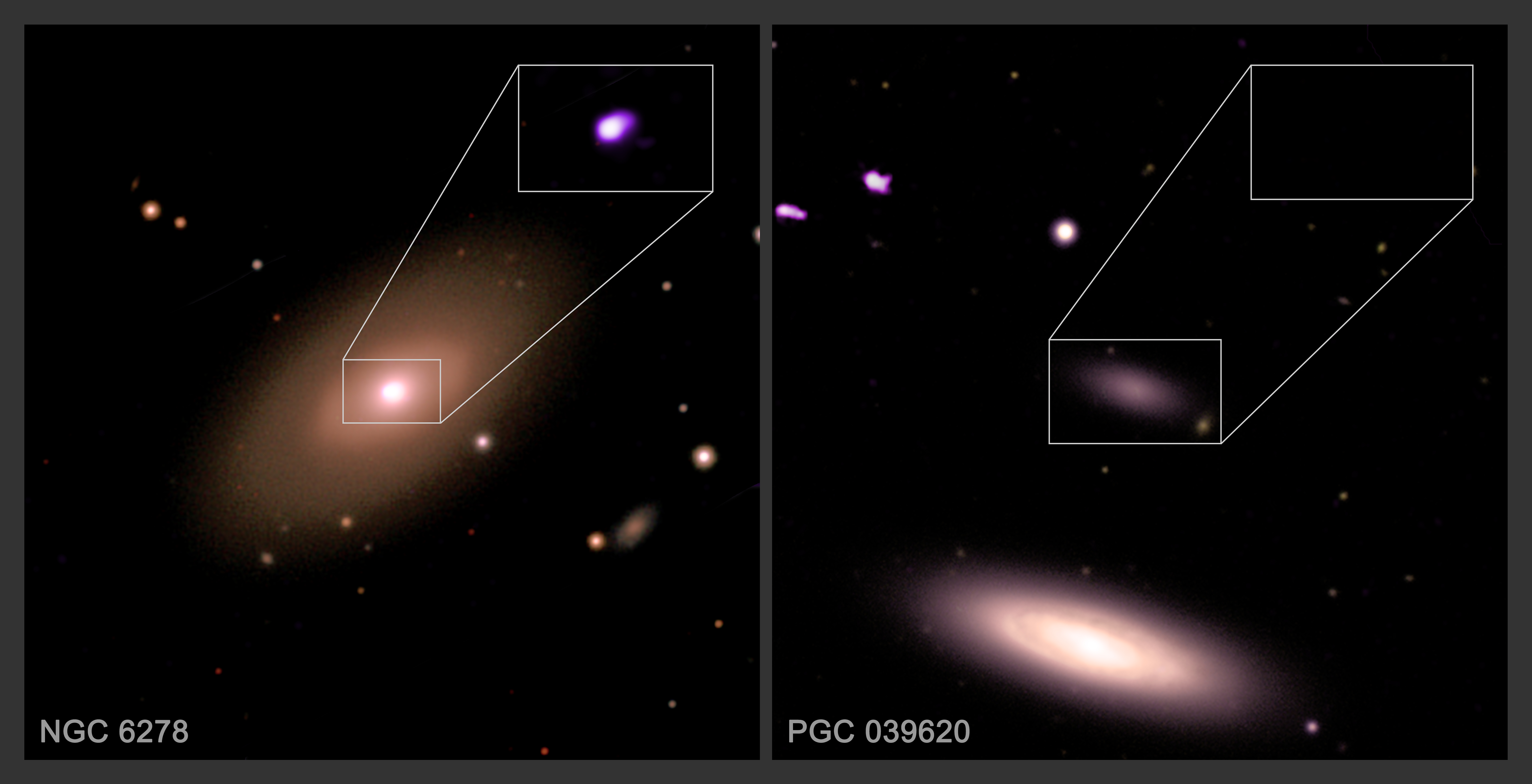
| Example Galaxy (SMBH present) | NGC 6278 (similar size to Milky Way) |
| Example Galaxy (SMBH likely absent) | PGC 039620 (smaller galaxy) |
Expert Verdict
The Chandra X-ray Observatory's latest findings represent a pivotal advancement in our understanding of supermassive black hole distribution and galactic evolution. By demonstrating that SMBHs are not as universally present in dwarf galaxies as previously theorized, this research compels a re-evaluation of the mechanisms governing SMBH formation and their co-evolutionary relationship with host galaxies. The meticulous analysis of X-ray signatures over an extended observational period provides robust evidence that will inform future astrophysical models and observational campaigns, particularly those targeting the fainter and more elusive black hole populations in the universe's smaller galactic structures. This study underscores the critical role of long-duration, high-sensitivity X-ray astronomy in unraveling the universe's most profound mysteries.