

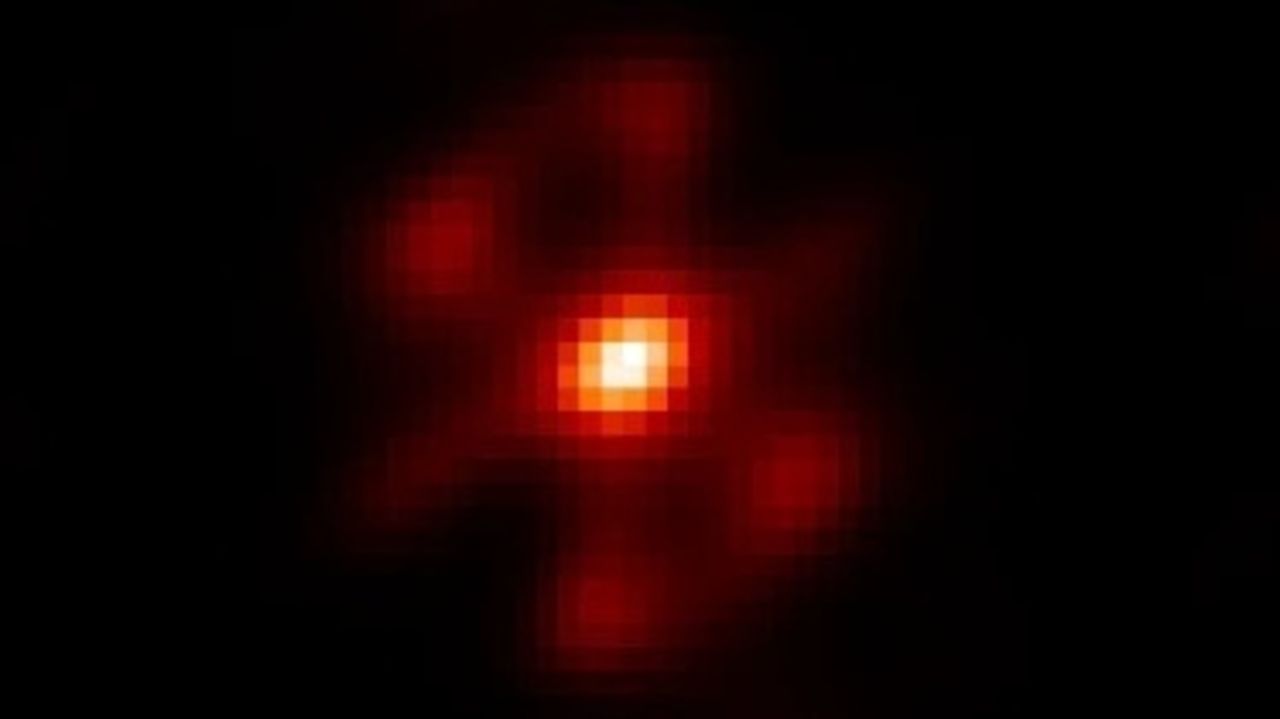
Unprecedented Close-Up Images Reveal the Complex Dynamics of Nova Explosions
For centuries, the sudden appearance of a "new star" in the night sky, a phenomenon dubbed a "nova" from the Latin for "new," has captivated astronomers. While the underlying mechanism of these stellar outbursts—thermonuclear explosions on the surface of white dwarfs in binary star systems—has been largely understood, the intricate details of these events remained elusive. Now, groundbreaking close-up images have provided an unprecedented look at two nova explosions, revealing a complexity far beyond previous assumptions and fundamentally reshaping our understanding of these cosmic spectacles.
Scientific Significance
The recent observations represent a significant leap forward in astrophysics, offering direct evidence that nova eruptions are not simple, singular events but rather involve multiple outflows of material and, in some cases, dramatic delays in the ejection process. This breakthrough challenges long-held theories and provides critical insights into the extreme physics at play during these stellar explosions.
Research Methodology and Data Accuracy
The detailed images were captured using a cutting-edge technique called interferometry at the Center for High Angular Resolution Astronomy (CHARA) Array, located on Mount Wilson in California. This array combines the light from six optical telescopes, effectively creating a single, much larger telescope with the resolving power equivalent to one nearly 330 meters wide. This exceptional resolution allowed astronomers to directly image the rapidly evolving explosions within days of their eruption, transforming what were previously unresolved points of light into detailed snapshots of cosmic violence. Complementary data from other observatories, including the International Gemini Observatory and NASA's Fermi Gamma-ray Space Telescope, provided crucial spectroscopic information, tracing the evolving chemical composition and linking high-energy emissions to the observed outflow structures.
The Mechanics of a Nova
A classical nova occurs in a binary star system where a dense stellar remnant, known as a white dwarf, gravitationally siphons hydrogen-rich material from a companion star, often a red giant. This accreted matter accumulates on the white dwarf's surface, forming a dense but shallow atmosphere. As the mass builds up, the temperature and pressure at the base of this layer increase dramatically, eventually triggering a runaway thermonuclear fusion reaction. This explosive event ejects the outer layers of hydrogen into space, causing the star system to brighten by several orders of magnitude, sometimes becoming visible to the naked eye. Unlike supernovae, which result in the complete destruction of the star, a nova does not obliterate the white dwarf, allowing the process to potentially repeat over cosmic timescales.
Unveiling Complex Ejections
The study focused on two distinct novae that erupted in 2021: Nova V1674 Herculis and Nova V1405 Cassiopeiae. Nova V1674 Herculis was one of the fastest novae ever recorded, brightening and fading within a few days. The CHARA images revealed two distinct, nearly perpendicular outflows of gas, indicating that the eruption involved multiple interacting ejections rather than a single, uniform blast. In stark contrast, Nova V1405 Cassiopeiae exhibited a much slower evolution. Its outer layers remained close to the star for more than 50 days before a large shell finally broke free, marking the first direct evidence of a delayed ejection in a nova.
The Role of Gamma-Ray Emissions
A significant aspect of these findings is the direct link between the complex outflow patterns and the production of high-energy gamma rays. NASA's Fermi Gamma-ray Space Telescope has previously detected puzzling gamma-ray emissions from over 20 novae, suggesting a more intricate process than a simple stellar flash. The new CHARA observations show that these gamma rays are generated by powerful shock waves created when different ejected material components violently collide, either from early interacting flows or from later episodes of released gas.
| Key Findings Summary | |
|---|---|
| Observed Novae | Nova V1674 Herculis, Nova V1405 Cassiopeiae (both 2021 eruptions) |
| Primary Instrument | Center for High Angular Resolution Astronomy (CHARA) Array (interferometry) |
| Complementary Data | International Gemini Observatory (spectroscopy), NASA's Fermi Gamma-ray Space Telescope (gamma-ray detection) |
| V1674 Herculis Characteristics | One of the fastest novae on record; brightened and faded in days; revealed two distinct, nearly perpendicular outflows of gas; gamma-ray emissions linked to colliding flows. |
| V1405 Cassiopeiae Characteristics | Slower evolution; delayed ejection of material for over 50 days; subsequent new shocks and gamma-ray production after delayed release. |
| Key Discovery | Nova eruptions are more complex than previously thought, involving multiple outflows, delayed ejections, and shock-powered gamma-ray generation. |
Expert Verdict
The ability to observe stellar explosions in real-time and with such fine detail marks an extraordinary leap forward in astronomy. As Elias Aydi, lead author of the study and assistant professor at Texas Tech University, noted, "These observations allow us to watch a stellar explosion in real time, something that is very complicated and has long been thought to be extremely challenging. Instead of seeing just a simple flash of light, we're now uncovering the true complexity of how these explosions unfold. It's like going from a grainy black-and-white photo to high-definition video." This sentiment is echoed by Gail Schaefer, Director of the CHARA Array, who stated, "The images give us a close-up view of how material is ejected away from the star during the explosion." John Monnier, a co-author from the University of Michigan, emphasized the significance, stating, "The fact that we can now watch stars explode and immediately see the structure of the material being blasted into space is remarkable. It opens a new window into some of the most dramatic events in the universe." Furthermore, Laura Chomiuk, a co-author from Michigan State University, highlighted the broader implications: "Novae are more than fireworks in our galaxy—they are laboratories for extreme physics. By seeing how and when the material is ejected, we can finally connect the dots between the nuclear reactions on the star's surface, the geometry of the ejected material and the high-energy radiation we detect from space." These findings solidify the role of novae as crucial natural laboratories for studying shock physics and particle acceleration, promising to unlock deeper mysteries about how stars live, die, and influence their cosmic surroundings.