

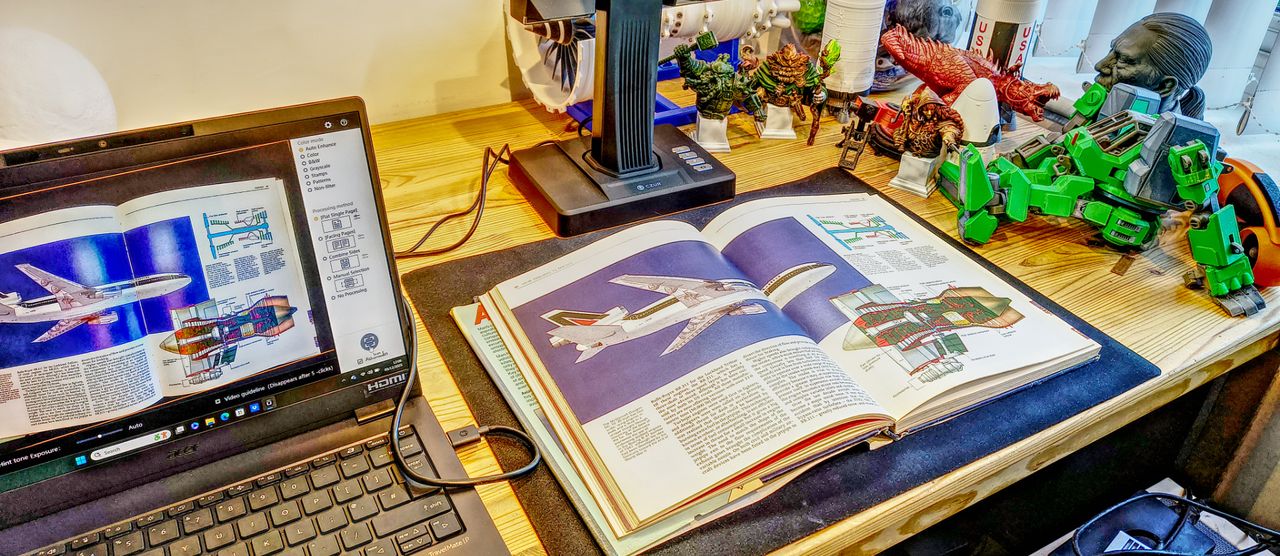
CZUR ET24 Pro Review: A Niche Book Scanner's Imperfect Dominance
The Verdict: The CZUR ET24 Pro book scanner, while far from flawless, stands as a surprisingly capable solution in a market starved for dedicated book digitization tools.
- The CZUR ET24 Pro offers specialized features like auto-flattening and OCR for efficient book scanning, addressing a critical need for institutions and serious hobbyists.
- Despite its premium price, the scanner suffers from outdated connectivity, questionable hardware choices, and design quirks that hinder optimal user experience.
- The limited competition in the dedicated overhead book scanner market means users often have to overlook the ET24 Pro's shortcomings.
In an era brimming with cutting-edge smart devices and lightning-fast connectivity, we often overlook the specialized tools that serve critical, albeit niche, functions. Traditional flatbed scanners have largely been relegated to receipt capture or occasional document digitization, while industrial behemoths handle high-volume paper trails. Yet, there remains a significant gap for those tasked with the delicate and precise art of document digitization of bound materials – a challenge the CZUR ET24 Pro book scanner attempts to address. From our perspective at NexaSpecs, the ET24 Pro steps into this void, promising advanced solutions for capturing curved pages and preserving invaluable texts.
However, as with many specialized devices operating in less competitive arenas, the question isn't just about what it *can* do, but how elegantly and efficiently it accomplishes its goals. We believe a deeper dive reveals a device that is both essential for its purpose and frustrating in its execution, a dichotomy we intend to dissect for our discerning readers.
Who Is This For?
The CZUR ET24 Pro book scanner is explicitly designed for institutions, academic libraries, archives, legal professionals, and serious hobbyists who regularly need to digitize fragile books, historical documents, or bound reports without damaging them. Its auto-flattening technology makes it an ideal scanner for preserving old books and creating searchable digital archives. If your workflow involves high-volume book scanning for research, preservation, or public access, this device warrants serious consideration. For casual users looking to scan a single book, the price point of $649 likely makes it an excessive investment.
Critical Analysis
Our initial impressions of the CZUR ET24 Pro, based on data from TechRadar Reviews, paint a picture of a purpose-built machine that, while functional, struggles with several foundational aspects of modern tech design. The core proposition—efficiently scanning books with a camera-based system—is undeniably valuable. Traditional flatbeds are simply inadequate for bound materials, often requiring damaging force to flatten pages or resulting in distorted scans. The ET24 Pro's overhead design, coupled with its advanced software, is a clear differentiator here.
The device features a 24MP camera, a crucial component for capturing high-resolution images up to A3 size (16.5” x 11.7”). This resolution is vital for ensuring legibility, especially when dealing with fine print or detailed illustrations in historical texts. The software's ability to auto-flatten curved pages and de-skew images is the scanner's standout feature, leveraging three laser rays to profile page curvature, although we find the claim of "lasers" without visible light somewhat perplexing. This technological intervention transforms what would otherwise be a cumbersome and error-prone manual process into something far more manageable. Furthermore, the integrated ABBYY OCR, supporting over 180 languages, is a powerful addition, converting scanned images into searchable and editable text – a non-negotiable for modern document processing and AI applications.
✅ Pros & ❌ Cons
| ✅ Pros | ❌ Cons |
|
|
The Bigger Picture
The landscape of document capture has evolved dramatically over the decades, from cumbersome photocopiers to compact flatbeds, and now to sophisticated overhead scanners like the CZUR ET24 Pro. Yet, the core challenge of digitizing bound materials without causing damage has remained a niche problem, often addressed by bespoke solutions or painstaking manual photography. The ET24 Pro, with its integrated lighting and camera system, represents a significant step forward for book preservation and access, allowing rare and fragile texts to be shared widely without physical wear and tear.
However, our analysis reveals a device stuck in a perplexing temporal loop. The inclusion of a software CD in 2025 is an anachronism that speaks volumes about the perceived target market or, perhaps, a lack of adaptation to modern computing standards. Similarly, the reliance on USB 2.0 Type-A for connectivity feels like a relic from a bygone era, especially when juxtaposed against the high-speed data transfer capabilities of contemporary devices like the latest Poco F8 Ultra or the swift Wi-Fi 7 mesh systems we recently reviewed, such as the TP-Link Deco BE65 Pro. This isn't just about convenience; slower transfer speeds can impede efficient workflows in professional environments where every second counts.
The internal specifications, particularly the "dual-core OpenRISC 32-bit" processor and "1Gbit DDR" memory, raise further questions. In an age where even mid-range smartphones boast multi-core 64-bit ARM SoCs with gigabytes of high-speed RAM, the ET24 Pro's internal hardware feels underpowered for the complex image processing tasks it undertakes. We ponder why CZUR didn't opt for more readily available, powerful, and cost-effective off-the-shelf mobile electronics, which could have enabled features like wireless connectivity and USB-C. This design philosophy, or lack thereof, contributes to a higher price tag than we might expect for a device with such dated components, especially given the largely plastic construction.
Despite these criticisms, we acknowledge the scarcity of direct competitors. As TechRadar Reviews points out, many similar products are often rebadged CZUR devices, effectively giving the company a near-monopoly in this segment. This lack of market pressure likely contributes to the stagnation in design and component choices. For those whose work mandates the digitization of books, the CZUR ET24 Pro, with all its quirks, remains one of the few viable options, making its imperfections a necessary compromise rather than a deal-breaker.
What This Means for You
For potential purchasers, especially those in archival or academic settings, understanding the CZUR ET24 Pro's strengths and weaknesses is paramount. Its ability to accurately capture and flatten book pages, along with robust OCR, makes it an invaluable tool for creating accessible digital libraries and preserving historical records. The sheer efficiency gained by not having to manually photograph or struggle with a flatbed scanner cannot be overstated for high-volume tasks.
However, you must approach this investment with realistic expectations. The build quality, while functional, doesn't inspire confidence for a device at this price point. Be prepared to manage a somewhat cluttered workspace due to the multiple cables and the essential scanning mat. Furthermore, the software, while powerful in its core functions, lacks the intuitive workflow and modern interface we've come to expect from contemporary applications. The absence of automatic, unique file naming for scanned pages is a significant oversight that can complicate large-scale digitization projects, potentially leading to organizational headaches if not managed meticulously.
Before committing to the CZUR ET24 Pro book scanner, we strongly advise developing a comprehensive digitization strategy. Consider how scanned files will be named, stored, indexed, and integrated into existing databases. Without a clear plan, even the most advanced scanner can become an underutilized piece of equipment. Lastly, we must echo the crucial point regarding copyright: ensure you understand the legal implications of digitizing copyrighted materials in your jurisdiction before undertaking any scanning projects. This device provides the capability, but legal compliance remains the user's responsibility.
Analysis and commentary by the NexaSpecs Editorial Team.
What are your thoughts on specialized tech solutions that dominate a niche despite apparent flaws? Do you prioritize unique functionality over modern conveniences and build quality? Let us know in the comments below!
📝 Article Summary:
CZUR ET24 Pro Review: A Niche Book Scanner's Imperfect Dominance The Verdict: The CZUR ET24 Pro book scanner, while far from flawless, stands as a surprisingly capable solution in a market starved for dedicated book digitization tools. 📌 Key Takeaways Th...
Words by Chenit Abdel Baset